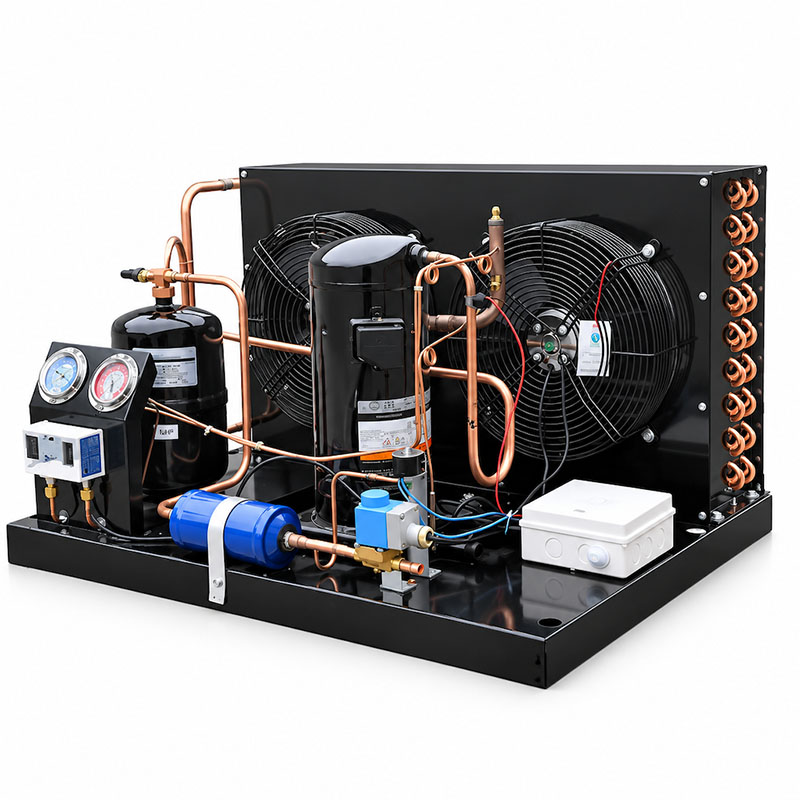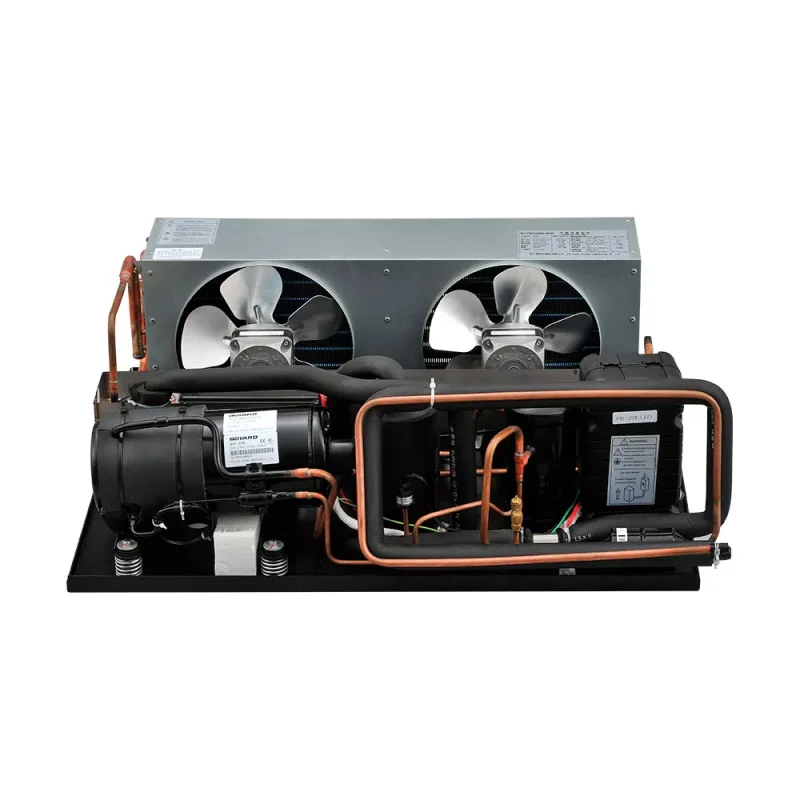
Copeland ZB48KQE Scroll Condensing Unit
The capacity sweet spot: more headroom than a small unit, without the complexity of an industrial system
There is a particular size of refrigeration job that contractors know well. It is bigger than a single walk-in cooler, but it is not yet a full plant-room installation. The room runs long hours, the product inside it matters, and the client expects the equipment to be boring — in the best possible sense. The Copeland ZB48KQE condensing unit, supplied as an open-type air-cooled package, is aimed directly at that middle band. It takes a slightly larger scroll core than the smaller ZB variants and wraps it in a chassis that keeps airflow, service access and installation logistics refreshingly simple.
Product Positioning: The Middle That Deserves Better Equipment
Commercial refrigeration catalogues tend to push buyers toward either end of the spectrum — compact units for small retail, and heavy industrial racks for large facilities. The projects in between often get squeezed into whichever end is closest, and the result is usually a compromise. A small unit runs flat out and wears itself down; a large system brings controls and piping complexity the project does not need.
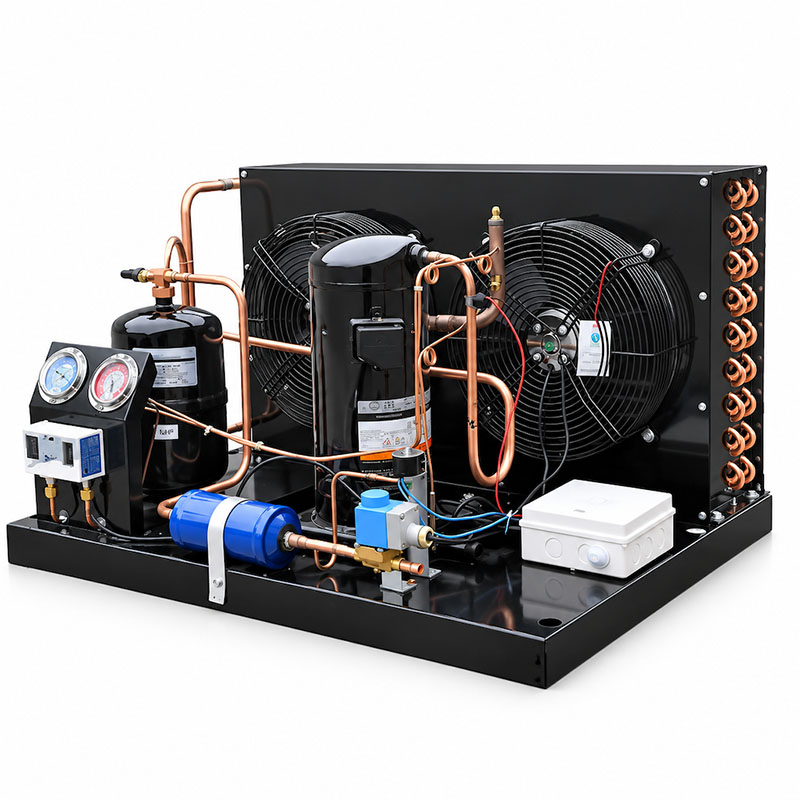
The ZB48KQE condensing unit exists to fill that gap. It pairs a Copeland ZB scroll compressor — a family developed specifically for commercial refrigeration duties — with an open-frame air-cooled layout. The compressor, receiver, filter drier, sight glass, pressure controls and interconnecting piping all sit on an exposed frame rather than inside a sealed cabinet. Air reaches the condenser coil without passing through louvers. Heat dissipates from around the compressor instead of collecting in a closed box. And every component stays visible, testable and reachable for the whole of the machine's service life.
In short, it is positioned as the unit you specify when the load has grown past what a compact model can handle comfortably, but the project still values simplicity over scale.
Where does the 48 sit in the ZB family? Click a rung.
Light duty
Medium load
Long duty cycles
Multi-room systems
This ladder shows relative positioning within the ZB family for orientation only. Exact capacity depends on refrigerant, evaporating temperature, condensing temperature and compressor variant. Always confirm against the current manufacturer datasheet before specifying.
Where It Fits: Applications That Reward Headroom
The ZB scroll platform is oriented toward medium-temperature refrigeration — chilled storage, preparation areas and holding rooms rather than deep-freeze duty. Within that band, the 48 core is most at home where the unit will run for long stretches and a little capacity headroom genuinely matters:
- Large walk-in coolers holding dairy, produce, beverages or chilled prepared food, where door traffic is heavy and temperature stability protects shelf life.
- Central kitchens and preparation rooms adjacent to cooking lines, where ambient heat is high and the unit must keep working through a full service shift.
- Supermarket and convenience-store back-of-house storage rooms, where quiet operation and service access in shared corridors both count.
- Food processing areas handling meat, bakery or prepared products, where airborne dust and flour make routine coil cleaning essential.
- Cold-chain staging and dispatch rooms, where product waits between transport legs and temperature excursions become rejected loads.
- Light process cooling for mixing areas, chemical storage and small controlled-environment workshops.
Core Advantages: A Recognised Core in an Accessible Chassis
Proven Scroll Core
The Copeland ZB family is built for commercial refrigeration, with continuous compression, no suction or discharge valves, and smooth gas flow.
Open-Frame Airflow
Air reaches the condenser without passing through louvers, and heat does not collect around the compressor in a confined plant room.
Sized With Headroom
Condenser area is deliberately generous, so the unit is not pinned against its limits on the hottest afternoons of the year.
Compliant Scroll Behaviour
Many ZB compressors use compliant scroll technology, allowing the scroll set to separate briefly under an upset rather than absorbing it as permanent damage.
Quiet, Low-Vibration Running
Scroll geometry produces little torque variation, and vibration-damped mounting keeps mechanical stress and noise low.
Standard Components
Widely available compressor and controls keep repairs local and supply chains short, with no proprietary lock-in.
Running Stability Across the Season
Stability is a design outcome, not a single component's property. The scroll core contributes smooth gas flow, low pulsation and few moving parts — no valves to fatigue, no pistons to wear. The unit architecture contributes generous condenser area, so condensing pressure stays controlled even when ambient temperatures climb. The compressor mounts on a rigid, vibration-isolated base that keeps bearing loads low across long running hours. Fans are balanced and guarded, reducing noise and protecting blades during service.
The open frame adds a quieter form of stability. Because nothing is enclosed, component temperatures stay closer to ambient, pressure controls remain testable in place, and early warning signs — oil staining, unexpected frost patterns, a discoloured terminal — are visible on a routine walk-past rather than discovered during a breakdown at peak season.
Why the middle band matters. A unit that is slightly too small runs flat out and ages quickly. A unit that is wildly oversized short-cycles and wastes energy. The ZB48 sits where capacity headroom and running discipline actually meet — which is exactly where most commercial cold rooms live.
Energy Efficiency: Condenser Discipline, Not Claims
In any vapour-compression system, the biggest efficiency lever is the gap between condensing temperature and ambient temperature. Compressor power rises quickly as that gap widens, which is why a clean, generously sized, well-ventilated condenser is worth more than almost any other upgrade on a medium-temperature system. As a widely used engineering rule of thumb, each 1 K reduction in condensing temperature translates into roughly a 2–3 % reduction in compressor energy consumption — approximate and system-dependent, but directionally reliable.
This unit supports that principle in practical ways. Coil geometry is chosen to maximise air-side contact rather than to fit a convenient cabinet dimension. Fan and motor selection prioritises airflow per watt over raw airflow. The open frame removes recirculation losses that enclosed units suffer when installed with limited clearance. And because the coil face is fully exposed, routine cleaning actually happens — quietly the most effective efficiency measure on any refrigeration site, and the one most often skipped.
Maintenance Convenience: Fewer Reasons to Dismantle
Scroll compressors already reduce the maintenance schedule by removing valve service from the list. The open frame removes the other common frustration: having to take equipment apart before you can diagnose it.
- Compressor, terminals and pressure controls are directly reachable — no panel removal before the first test.
- Sight glass and filter drier face outward so charge and moisture status can be read in seconds.
- The full condenser coil face can be brushed or washed with low-pressure water without dismantling guards.
- Fan motors and blades are serviceable from outside the frame, cutting replacement downtime.
- Standard, widely available parts — including the compressor itself — keep repairs local and predictable.
Installation position assessor — made for an open-frame unit
An open frame is a service advantage, but it does mean the installation position deserves a moment's thought. Choose the closest description of your site and see what to check before commissioning.
Practical Value Across the Project Chain
For the contractor, a factory-assembled and tested package means site time goes into piping, wiring and commissioning rather than fabrication — and a recognised compressor core means fewer challenges during submittal review. For the procurement team, the specification is legible: compressor model, unit frame, coil arrangement and controls are all identifiable and comparable across suppliers, which makes tendering and repeat ordering simpler. For the end user, the payoff arrives as steadier product temperature, quieter operation, a maintenance routine that fits a normal service contract, and spare parts that are not tied to a single distributor.
It is worth saying plainly what this unit is not. It is not a deep-freeze solution, and it is not a replacement for an engineered industrial rack. It is a medium-temperature condensing unit sized to sit in the productive middle of commercial refrigeration — and to do so with the kind of service access that keeps a maintenance budget honest.
Frequently Asked Questions
How do I know whether the ZB48 is the right size for my room?
The honest answer is that you cannot tell from the room's floor area alone. Capacity depends on product type, incoming product temperature, door traffic, insulation, ambient design condition and target room temperature. Send us those details and we will run the selection against the actual duty — including the evaporator match and refrigerant — rather than estimating from the room name.
Can this unit be used for frozen storage?
The ZB scroll platform is generally oriented toward medium-temperature refrigeration. Deep-freeze duty involves a much higher compression ratio and a different compressor family altogether. Do not assume suitability from the unit's physical size — confirm the compressor's approved operating envelope against your evaporating and condensing conditions before specifying.
Why is there no cabinet around the compressor?
An open frame improves airflow to the condenser, prevents heat from collecting around the compressor in confined plant rooms, and keeps every component visible and reachable. The trade-off is that the unit benefits from a sheltered or covered location rather than fully exposed outdoor mounting. Use the installation assessor above to see how your site compares.
Which refrigerants does the ZB series support?
The ZB series has historically been applied with common HFC refrigerants in commercial refrigeration, and later variants support HFO blends used as lower-GWP replacements. Refrigerant suitability, oil type and charge must be confirmed against the current manufacturer documentation for the exact compressor variant and the complete system, not inferred from the family name.
What documentation can you supply for a tender submission?
Dimensional drawings, compressor data, electrical information, refrigerant guidance and capacity information are available on request, so consulting engineers and contractors can complete submittals without relying on assumptions.
Get the Middle Band Right
If your project sits between a compact walk-in and a full plant installation, that is exactly the gap this unit was built to fill. Tell us the room volume, product type, target temperature, design ambient and refrigerant — plus anything you know about how the space will be used — and we will confirm whether a ZB48KQE-based unit is the right match, or point you toward a better-fitting configuration.
You will get capacity information, drawings and a clear quote. No obligation and no pressure — just refrigeration engineering from people who read the compressor line first.
Request Technical Data & a Quote →