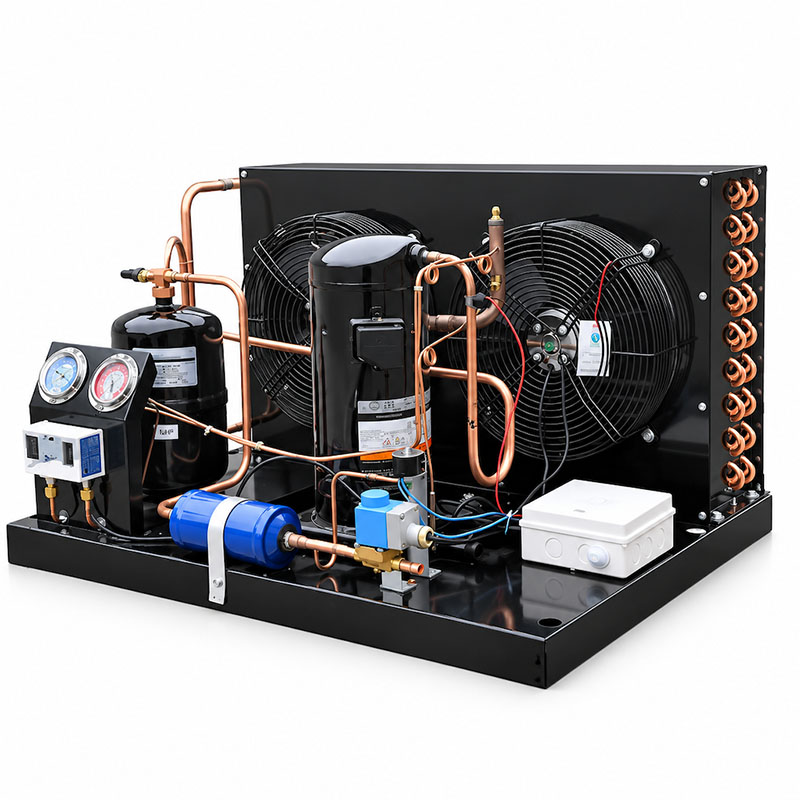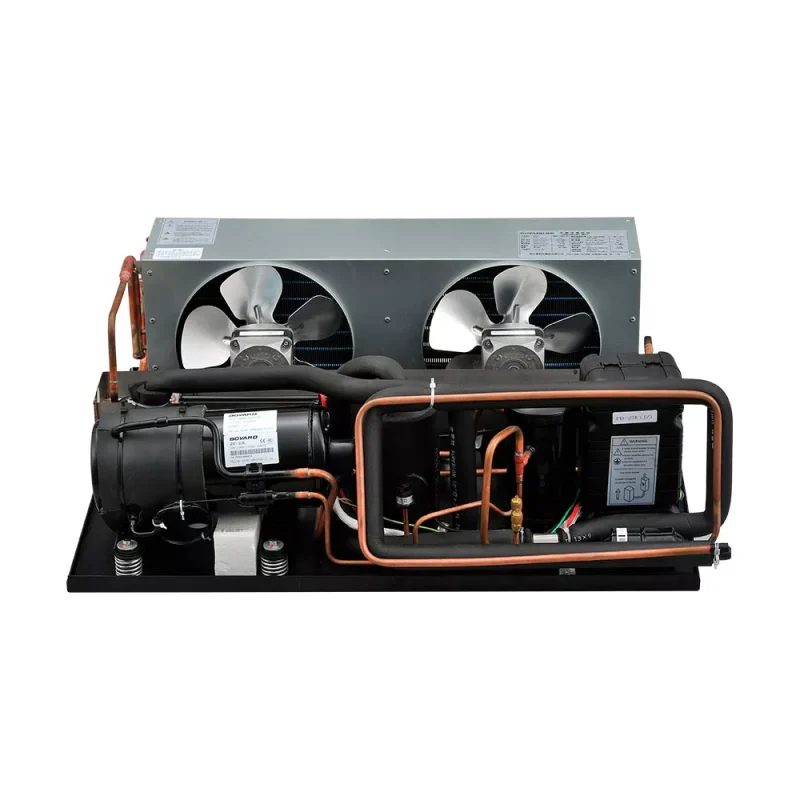
Boyard BYGF-030QXD-SMDP Open-Type Air-Cooled Condensing Unit
Engineered for the long run: a high-capacity condensing unit judged by year three, not week one
Most condensing units look convincing on a commissioning sheet. The real test comes later — after two summers of dust on the coil, after the first replacement fan motor, after the maintenance budget has been squeezed for the third year running. The Boyard BYGF-030QXD-SMDP open-type air-cooled condensing unit is designed to be judged on that timeline. It is a high-capacity unit in the BYGF family, and the SMDP configuration is aimed at projects where the equipment will be worked hard and expected to stay predictable: large cold rooms, processing halls, staging areas and long-duty cooling rooms.
01Product Positioning: A High-Load Unit With Nothing Sealed Away
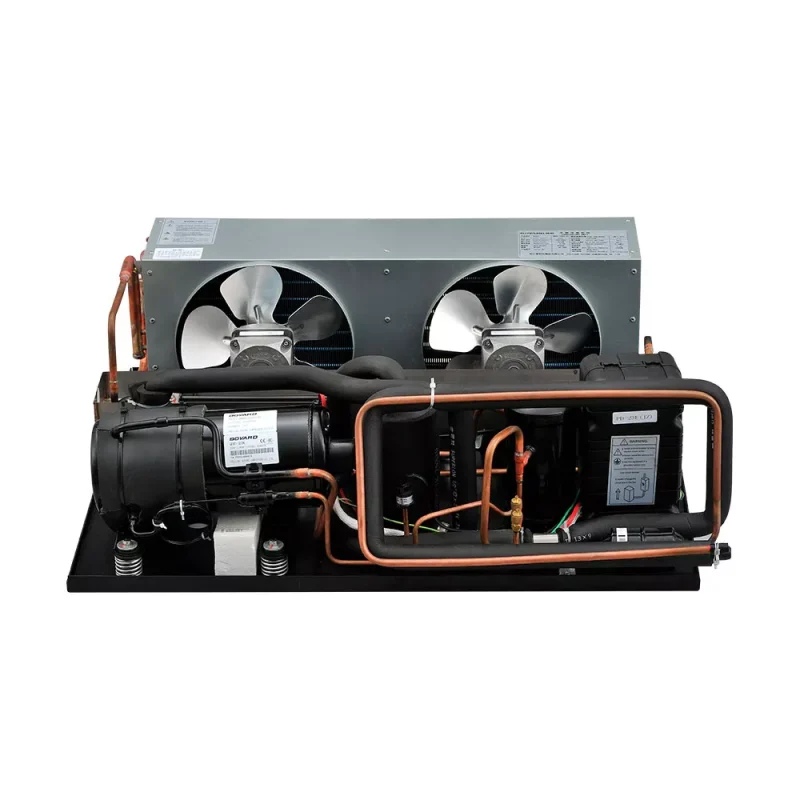
The BYGF-030QXD-SMDP places the compressor, receiver, filter drier, sight glass, pressure controls and interconnecting piping on an open frame rather than inside an enclosure. This is a deliberate engineering choice rather than a cost-saving shortcut. An open frame means air reaches the condenser coil without passing through louvers or fighting recirculation, heat does not accumulate around the compressor in a tight plant room, and every component can be inspected, tested and replaced without removing a panel.
Within the BYGF range, the 030QXD frame carries the higher end of the capacity ladder. The SMDP configuration is specified for installations where the unit will sit at the centre of a refrigeration system — matched with a separately selected evaporator and asked to hold temperature through long daily running hours. It is the kind of equipment a contractor keeps in the standard offering precisely because it behaves the same way on every project.
The design question we kept asking: if this unit has to be serviced ten times over its life, what does each of those visits look like? Every layout decision on the 030QXD frame answers that question before it answers anything about styling.
02Three Operating Profiles, One Platform
Rather than a long list of room types, it helps to think about how the unit is actually used. Three operating profiles cover most of the projects this frame is specified for.
The Large Holding Room
Chilled or frozen storage with steady occupancy, frequent door openings during dispatch hours, and a product load that does not tolerate temperature excursions.
Why the 030QXD-SMDP: condenser headroom keeps pressure stable through afternoon peaks, and the exposed coil face makes routine cleaning a ten-minute task rather than a shutdown.
The Processing Hall
Preparation and production areas where the unit runs alongside washdown, dust and airborne flour or fat, and where downtime directly stops production.
Why the 030QXD-SMDP: front-facing sight glass, drier and controls let a technician read system condition in seconds, and standard spare parts keep the fix local and fast.
The Staging and Sorting Area
Docking bays and sorting halls with high ambient temperatures, variable load and a maintenance window that is often scheduled at short notice.
Why the 030QXD-SMDP: open architecture tolerates imperfect airflow around the unit, and the vibration-isolated compressor mount keeps noise and mechanical wear in check through long shifts.
03Open Frame vs. Enclosed Cabinet: The Practical Difference
Enclosed condensing units are not inherently bad equipment, but the trade-offs show up over a service life. Here is how the two approaches compare on the points that matter to installers and owners.
| Consideration | Open-frame (BYGF-030QXD-SMDP) | Typical enclosed cabinet |
|---|---|---|
| Airflow to coil | Direct and unobstructed; less sensitivity to nearby walls and equipment | Depends on louver clearance; recirculation possible in tight plant rooms |
| Component access | Immediate — no panels to remove before diagnosis begins | Panels must be unbolted; working space inside the cabinet is limited |
| Heat around compressor | Dissipates freely; no trapped hot zone | Can build up inside the enclosure, especially in still air |
| Coil cleaning | Full coil face exposed; brush or low-pressure wash in minutes | Often requires partial disassembly or restricted access |
| Visual inspection | Leaks, frost patterns and wiring condition visible at a glance | Hidden until a fault forces the cabinet open |
| Footprint & protection | Compact frame; benefits from a covered or sheltered location | Better suited to fully exposed outdoor mounting |
The conclusion is straightforward: if the unit will live in a plant room, a covered compound or an accessible service area, the open frame consistently gives back more in service time and diagnostic clarity than it asks for in weather protection.
04Stability Through the Season, Not Just at Start-Up
At this capacity level, instability is expensive. A large room has little thermal buffer, so pressure swings translate quickly into product risk. The BYGF-030QXD-SMDP addresses this in three ways: condenser area is sized with deliberate headroom so the unit is not pinned against its limits on the hottest days; the compressor sits on a rigid, vibration-damped base that keeps mechanical stress and bearing wear low; and the fan assemblies are balanced and guarded, which reduces noise and protects blades during service.
The open layout contributes as well. Because nothing is enclosed, component temperatures stay closer to ambient, pressure controls remain testable in place, and early warning signs — oil staining, frost patterns, loose terminals — are visible during a routine walk-past rather than discovered during a failure.
05Where the Energy Goes
In a condensing unit, energy performance is dominated by one relationship: the higher the condensing temperature relative to ambient, the more work the compressor does for the same cooling effect. Every design feature that keeps condensing temperature down therefore pays back continuously — not once, but across every operating hour of the year.
The 030QXD frame supports that in practical terms. Coil geometry is chosen to maximize air-side contact rather than to fill a catalogue dimension. Fan and motor selection prioritizes airflow per watt over raw airflow. And the open frame removes the recirculation losses that enclosed units can suffer when installed with limited clearance. Layer on top of this the simplest efficiency measure of all — a clean coil — and the unit's running cost stays close to its design intent for far longer.
06Service Access as a Design Feature, Not a Convenience
Maintenance convenience is often treated as a nice-to-have in marketing copy. On a high-capacity unit it is a cost line. The 030QXD frame is laid out so that the most frequent service tasks require the least dismantling:
- Compressor, terminals and pressure controls are directly reachable for diagnosis and repair.
- Sight glass and filter drier face outward, so charge and moisture status can be checked without moving anything.
- The full condenser face can be brushed or washed down without removing guards or panels.
- Fan motors and blades are serviceable from outside the frame, shortening motor replacement downtime.
- Standard spare parts keep the owner out of a single-source supply trap and let local technicians carry out routine repairs.
07Value Across the Project Chain
For the contractor, the SMDP configuration arrives factory-assembled and tested, with the refrigeration circuit complete and the electrical layout defined — so site time goes into piping, wiring and commissioning rather than fabrication. For the procurement team, the frame carries a clear bill of materials, consistent performance data and a competitive cost base at the higher capacity band, which makes tendering and repeat ordering simpler. For the end user, the payoff is quieter, steadier operation, a maintenance routine that does not require specialist access equipment, and a unit that a local technician can keep running long after the warranty ends.
Field notes
On clearance: keep the coil face and fan discharge clear. Open frames tolerate imperfect airflow far better than cabinets, but "better" is not "immune".
On cleaning: a coil cleaned on schedule is the cheapest efficiency upgrade available on any refrigeration site. It costs an hour; skipping it costs electricity every hour afterwards.
On documentation: record suction and discharge pressures at commissioning. Year-three diagnostics become dramatically easier when there is a year-one baseline to compare against.
Maintenance rhythm planner — build a sensible service schedule
Tell us about the site and we will outline a practical inspection and cleaning cadence for an open-frame condensing unit of this class.
08Frequently Asked Questions
How do I decide between the SMDP and SEDP configurations of this frame?
The two configurations are specified for different electrical and control requirements within the same frame family. Rather than guessing from the model code, send us your load calculation, ambient design condition and refrigerant preference — our engineering team will confirm which configuration matches your system and produce the corresponding data for your submittal.
Can it be used for frozen storage as well as chilled rooms?
Yes, subject to correct selection. Frozen duty involves a lower evaporating temperature and therefore a different compressor and coil selection, plus defrost provisions on the evaporator side. Capacity and refrigerant charge must be confirmed against the actual evaporating and condensing conditions, not assumed from the room name.
What causes most premature failures on units of this type?
In practice, not the compressor. Blocked condenser coils, incorrect refrigerant charge after an undocumented top-up, and loose electrical terminations account for a large share of avoidable faults. All three are easier to catch on an open-frame unit, which is one of the strongest arguments for the layout.
Do you supply drawings and data for tender submissions?
Yes. Dimensional drawings, capacity information, electrical data and refrigerant guidance are available on request so consultants and contractors can complete submittals without relying on assumptions.
Put This Unit on Your Next Specification Sheet
If you are sizing a large cold room, replacing equipment that has become a maintenance liability, or standardizing a condensing unit across several sites, the BYGF-030QXD-SMDP is worth a proper technical review rather than a catalogue glance.
Send us the room volume, product type, target temperature, design ambient and refrigerant — plus anything you know about how the space will be used. We will come back with a configuration recommendation, supporting data and a clear price. No obligation, just refrigeration engineering.
Request Technical Data & a Quote →Copeland ZB45KQE Scroll Condensing Unit
Boyard BYGF-030-QXD-SEDP Open-Type Air-Cooled Condensing Unit