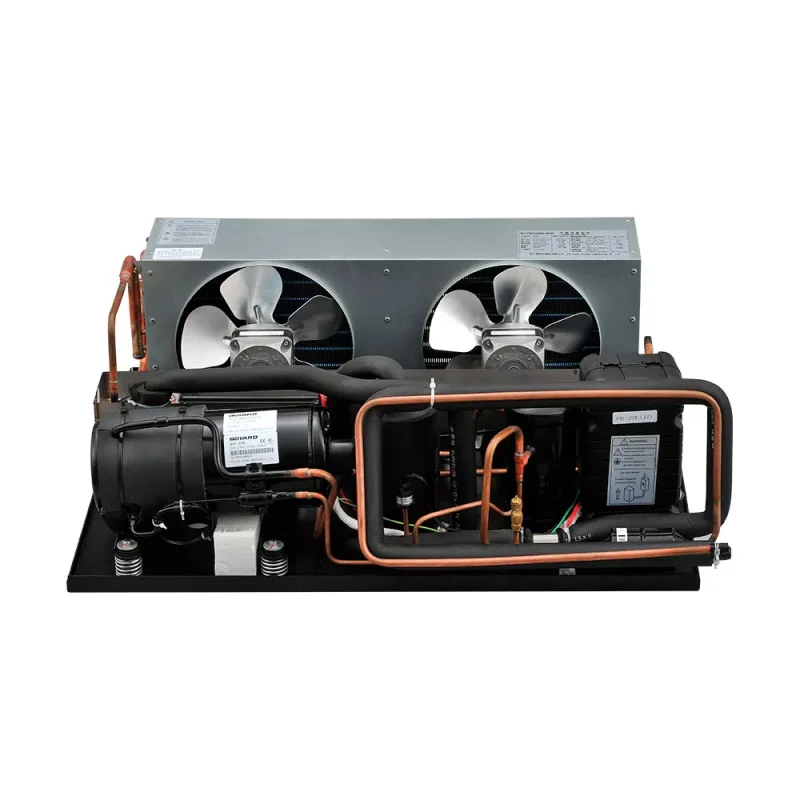
Copeland ZB45KQE Scroll Condensing Unit
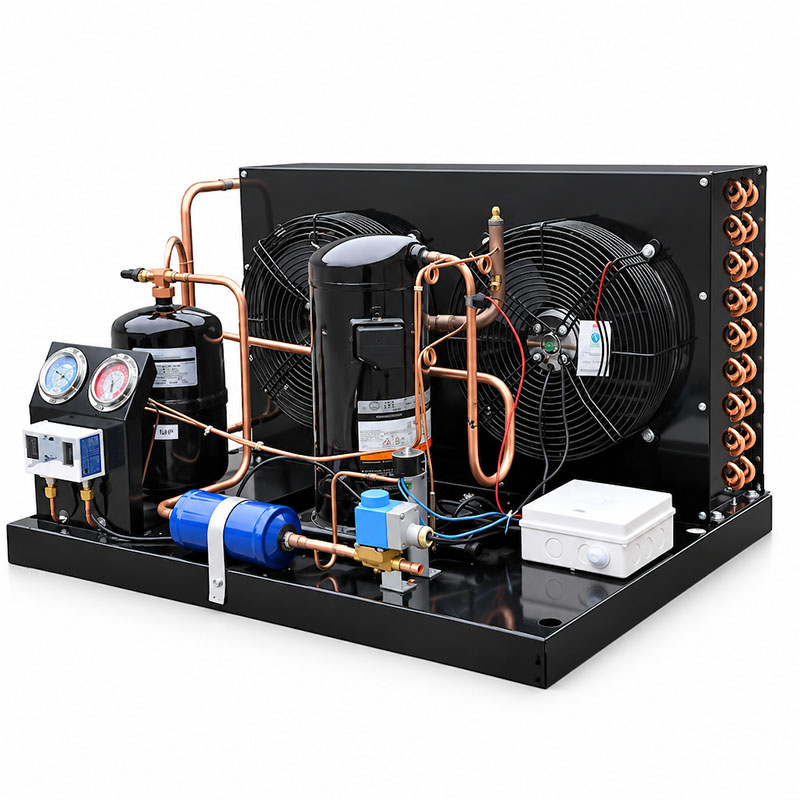
An open-type air-cooled unit built around a compressor name that refrigeration engineers already trust
When a buyer compares condensing units, the first pages of the catalogue usually show the cabinet, the fan guard and the coil. Experienced contractors skip ahead — they turn to the compressor specification, because that single component sets the capacity ceiling, the reliability floor and the shape of the maintenance cost curve for the next decade. A condensing unit built around the Copeland ZB45KQE scroll compressor is designed for buyers who read the specification sheet in that order. It pairs a widely recognised medium-temperature scroll with an open-frame air-cooled layout, so the machine is as easy to work on as it is predictable to own.
Read the model code — click each segment
Model-code interpretation shown here follows the general naming logic of the Copeland ZB series and is provided for orientation only. Always confirm exact capacity, electrical data, refrigerant suitability and application limits against the current manufacturer datasheet before specifying or ordering.
Product Positioning: Compressor Heritage, Open-Frame Delivery
There are two parts to this unit, and they matter for different reasons. The first is the compressor. The Copeland ZB range is a scroll family developed specifically for commercial refrigeration duties, and the ZB45KQE sits among the larger displacement sizes in that family — the sort of capacity that suits a mid-sized walk-in cooler or a compact processing room rather than a domestic cabinet. Scroll geometry produces a continuous compression process with no suction or discharge valves to fatigue, very little torque variation, and notably smooth, quiet operation compared with reciprocating alternatives of similar capacity.
The second part is the unit architecture. Rather than burying that compressor inside a sealed enclosure, the condensing unit places it — along with the receiver, filter drier, sight glass, pressure controls and interconnecting piping — on an open frame. Air moves to the condenser coil without passing through louvers or turning corners. Heat radiates away from the compressor instead of collecting in a closed box. And every component remains visible, testable and reachable for the life of the machine.
Put those two halves together and you get a unit positioned squarely in the mainstream of commercial refrigeration: a well-proven compressor core, delivered in a chassis that respects the realities of installation and service. It is not a specialist or niche product. It is the kind of equipment that belongs on a contractor's standard specification sheet because it behaves consistently from project to project.
Where It Fits: Medium-Temperature Duty
The ZB platform is oriented toward medium-temperature refrigeration — applications where evaporating temperatures sit comfortably above deep-freeze territory and the priority is steady product temperature rather than extreme low-temperature pull-down. Typical applications include:
Dairy, Produce and Beverage Rooms
Walk-in coolers holding product at chilled temperatures, where door traffic is frequent and stable temperature protects shelf life and presentation.
Central Kitchens and Preparation Areas
Rooms adjacent to cooking lines, where ambient heat is high and the unit must keep working while staff move in and out throughout the shift.
Supermarket Back-of-House
Storage and preparation rooms behind the sales floor, where quiet operation and service access in shared back corridors both matter.
Meat, Bakery and Prepared Food
Production areas that run long shifts, generate airborne dust or flour, and cannot afford unscheduled downtime in the middle of a batch.
Staging and Dispatch Rooms
Holding spaces where product waits between transport legs and temperature excursions translate directly into rejected loads.
Controlled-Environment Workshops
Non-food rooms requiring dependable, moderate cooling — mixing areas, chemical storage and small process enclosures.
Core Advantages: Why the Scroll Core Matters
Scroll compressors have earned their place in commercial refrigeration for reasons that show up on the balance sheet rather than in brochure photographs. The orbiting scroll compresses gas continuously across its pockets, so gas flow is smooth and discharge pulsation is low. There are fewer moving parts than in a reciprocating machine — no valves, no pistons, no connecting rods — which means fewer components to wear out. The result is quieter operation, lower vibration and a mechanical design that tolerates long running hours without the valve fatigue that eventually catches up with recip units.
Many Copeland scroll compressors also incorporate compliant scroll technology, allowing the scroll set to separate briefly under liquid slugging or debris rather than absorbing the impact as permanent damage. No compressor enjoys liquid return, but a compliant design gives the system a chance to recover from an occasional upset instead of turning a transient event into a compressor replacement.
Scroll vs. Reciprocating: An Honest Comparison
Reciprocating compressors remain perfectly valid for many duties, and no single technology wins on every point. But for medium-temperature commercial refrigeration at this capacity level, the trade-offs usually favour the scroll.
| Consideration | Scroll (ZB45KQE core) | Reciprocating alternative |
|---|---|---|
| Moving parts | Few — the scroll set performs the entire compression cycle | Pistons, rods, valves and springs all subject to fatigue |
| Discharge pulsation | Continuous, smooth gas flow with low pulsation | Pulsed discharge requiring attention to piping vibration |
| Noise and vibration | Typically quiet and low-vibration at comparable capacity | Higher mechanical noise and torque variation |
| Valve maintenance | No suction or discharge valves to service | Valve plates and reeds are a known wear item |
| Handling of upsets | Compliant scroll design can absorb brief liquid or debris events | Valve damage from liquid slugging is a common failure mode |
| Behaviour at high compression ratio | Efficiency falls in deep-freeze duty; best in medium temperature | Can remain viable in some low-temperature applications |
Running Stability You Can Plan Around
Stability in a refrigeration system is not one component's job — it is a design outcome. The scroll core contributes smooth gas flow and low mechanical stress. The unit architecture contributes something equally important: condenser area sized with headroom, so the unit is not pinned against its limits on the hottest afternoons of the year. The compressor mounts on a rigid, vibration-damped base that keeps mechanical stress and bearing wear low. Fans are balanced and guarded, reducing both noise and the risk of blade damage during service.
The open frame reinforces this in a quieter way: because nothing is enclosed, component temperatures stay closer to ambient, pressure controls remain testable in place, and the early warning signs of trouble — oil staining, unusual frost patterns, a discoloured terminal — are visible during a routine walk-past rather than discovered during a breakdown at peak season.
The real cost of a condensing unit is not the invoice. It is the electricity it consumes across ten years, plus every hour of labour it demands. A recognised compressor core and an accessible chassis are how you keep both of those numbers under control.
Energy Efficiency: The Condensing Temperature Lever
In any vapour-compression system, the single biggest efficiency lever available to the designer is the gap between condensing temperature and ambient temperature. Compressor power rises quickly as that gap widens, which is why an oversized, clean, well-ventilated condenser is worth more than almost any other upgrade on a medium-temperature system.
This unit supports that principle in several practical ways. Coil geometry is selected to maximise air-side contact rather than to hit a convenient cabinet dimension. Fan and motor selection prioritises airflow per watt over raw airflow. The open frame removes the recirculation losses that enclosed units suffer when installed with limited clearance. And because the coil face is fully exposed, routine cleaning actually happens — which is quietly the most effective efficiency measure on any refrigeration site. A fouled coil raises condensing temperature, and raising condensing temperature raises the bill every single hour.
As a rule of thumb widely used in refrigeration engineering, every 1 K reduction in condensing temperature translates into roughly a 2–3 % reduction in compressor energy consumption. That rule is approximate and system-dependent, but it explains why condenser discipline pays back continuously rather than once.
Running cost estimator — see what condenser discipline is worth
Enter your compressor input power, daily running hours and local electricity price. The estimator shows the annual energy cost and the approximate saving range from reducing condensing temperature by 3 K through good condenser sizing and regular coil cleaning.
Estimator for orientation only. It assumes the compressor runs at the entered input power for the full stated hours and ignores part-load behaviour, controls, fan power and defrost. The 2–3 % per kelvin figure is an industry rule of thumb, not a guarantee. Use manufacturer performance data for real design decisions.
Maintenance Convenience: Access Designed In, Not Bolted On
Scroll compressors already reduce the maintenance burden by removing valve service from the schedule. The open-frame layout removes the other common frustration: having to dismantle equipment before you can even diagnose it.
- Compressor, terminals and pressure controls are directly reachable — no panel removal before the first test.
- Sight glass and filter drier face outward so refrigerant charge and moisture status can be read in seconds.
- The full condenser coil face can be brushed or washed with low-pressure water without dismantling guards.
- Fan motors and blades are serviceable from outside the frame, cutting replacement downtime.
- Standard, widely available components — including the compressor itself — keep repairs local and supply chains short.
For an end user, the practical translation is simple: fewer hours billed per service visit, less chance of collateral damage during a repair, and a unit that a local technician can look after without specialist tooling or factory support.
Practical Value Across the Project Chain
For the contractor, a factory-assembled and tested unit means site time goes into piping, wiring and commissioning rather than fabrication — and a recognised compressor core means fewer questions from consulting engineers during submittal review. For the procurement team, the specification is legible: compressor model, unit frame, coil arrangement and controls are all identifiable and comparable across suppliers. For the end user, the payoff arrives in quieter operation, steady product temperature, a maintenance routine that fits into a normal service contract, and spare parts that are not tied to a single distributor.
Frequently Asked Questions
Is this unit suitable for frozen storage below -18 °C?
The ZB scroll platform is generally oriented toward medium-temperature refrigeration. Deep-freeze duty involves a much higher compression ratio and a different compressor selection altogether, often from a low-temperature scroll or semi-hermetic family. Do not assume suitability from the unit's physical size — confirm the compressor's approved envelope against your evaporating and condensing conditions before specifying.
Which refrigerants can the system run on?
The ZB series has historically been applied with common HFC refrigerants for commercial refrigeration, and later variants support HFO blends used as lower-GWP replacements. Refrigerant suitability, oil type and charge must be confirmed against the current manufacturer documentation for the exact compressor variant and the complete system — not just the compressor family.
Why does the unit have no cabinet around the compressor?
An open frame improves airflow to the condenser, prevents heat from collecting around the compressor in confined plant rooms, and keeps every component visible and reachable. The trade-off is that the unit benefits from a sheltered or covered location rather than fully exposed outdoor mounting. For plant rooms, service compounds and covered rooftops, the open layout consistently returns more in service time than it gives up in weather protection.
Can the unit be matched with a different evaporator than the one originally proposed?
Yes, subject to proper selection. The condensing unit and evaporator must be matched on capacity at the actual design conditions, refrigerant, and defrost method. Our team can verify the match and the expected refrigerant charge before you commit to the order.
What documentation is available for tender submissions?
Dimensional drawings, compressor data, electrical information, refrigerant guidance and capacity information are available on request so consulting engineers and contractors can complete submittals without relying on assumptions.
Specify It With Confidence
If you are selecting a medium-temperature condensing unit for a cold room, a processing area or a multi-site rollout, the compressor should be the first line of the conversation, not the last. Tell us your room volume, product type, target temperature, design ambient and refrigerant — and we will confirm whether a Copeland ZB45KQE-based unit is the right match, or point you toward a better-fitting configuration.
You will get capacity information, drawings and a clear quote. No obligation, no pressure — just refrigeration engineering from people who read specification sheets the same way you do.
Request Technical Data & a Quote →
Boyard BYGF-030QXD-SMDP Open-Type Air-Cooled Condensing Unit
Related Article