Choosing Right, Not Just Cheap: Danfoss MLZ021 Air-Cooled Condensing Units
Choosing Right, Not Just Cheap:
Danfoss MLZ021 Air-Cooled Condensing Units
A practical buying guide for refrigeration contractors, equipment purchasers and end users — because the most expensive unit on a project is the one you have to replace.
Where Condensing Unit Procurement Usually Goes Wrong
Six problems we hear about every single week.
Buying a box-type condensing unit looks simple on paper: pick a horsepower figure, match a cold room, send a purchase order. In practice, most project delays and callback visits trace back to the same handful of procurement decisions made early and reviewed too late.
Selection that is "close enough"
A unit sized on room volume alone will run short during pull-down and cycle too often at holding temperature. Capacity must be read at your actual evaporation and ambient temperatures — not at a catalogue headline point.
Brand traps and stripped configurations
A genuine compressor badge on a poorly built chassis is still a bad unit. Coil fin density, fan motor class, receiver volume and electrical protection are where corners quietly get cut.
Voltage that fits the drawing, not the site
Single-phase 220–240 V or three-phase 380–415 V is only half the story. Supply fluctuation, phase imbalance and 50/60 Hz differences decide whether the unit starts reliably at 3 a.m.
Refrigerant mismatch
R404A stock is shrinking, R452A and R448A/R449A are filling the gap — and expansion valves, oil type and charge weights must all agree with whichever one you land on.
Delivery that slips after the PO
Compressor allocation, coil production and shipping schedules do not always match a project's installation window. Confirm stock and build-to-order status before you commit a handover date.
Purchase price versus running cost
The cheapest unit on the quotation is rarely the cheapest unit over five years of electricity, refrigerant loss and service visits. Value engineering is not the same as cost cutting.
Meet the Unit: MLZ021 Box-Type Air-Cooled Condensing Unit
Compact scroll platform, medium-temperature duty, built to be serviced.
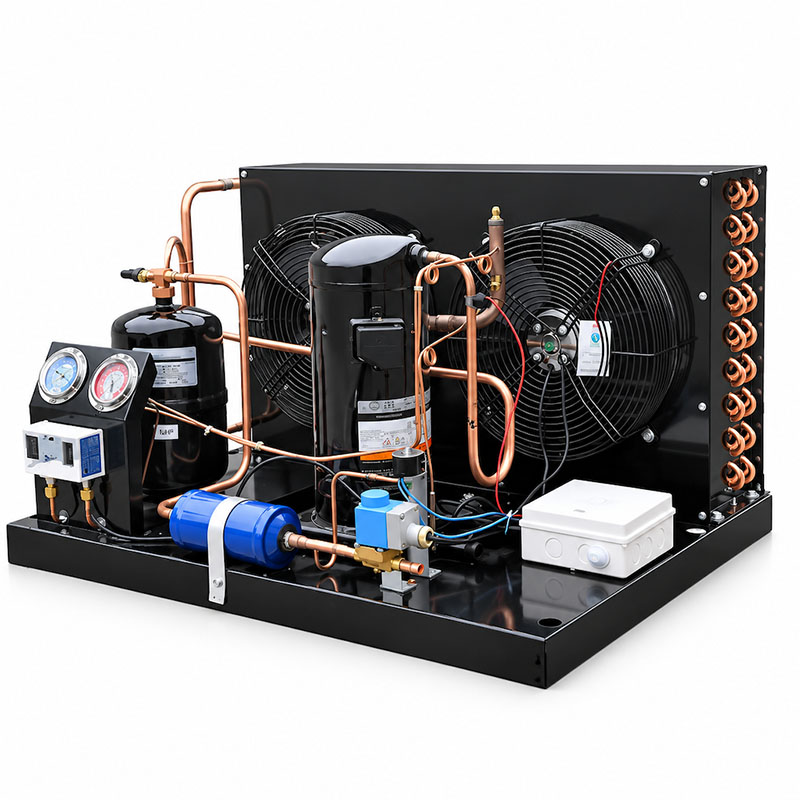
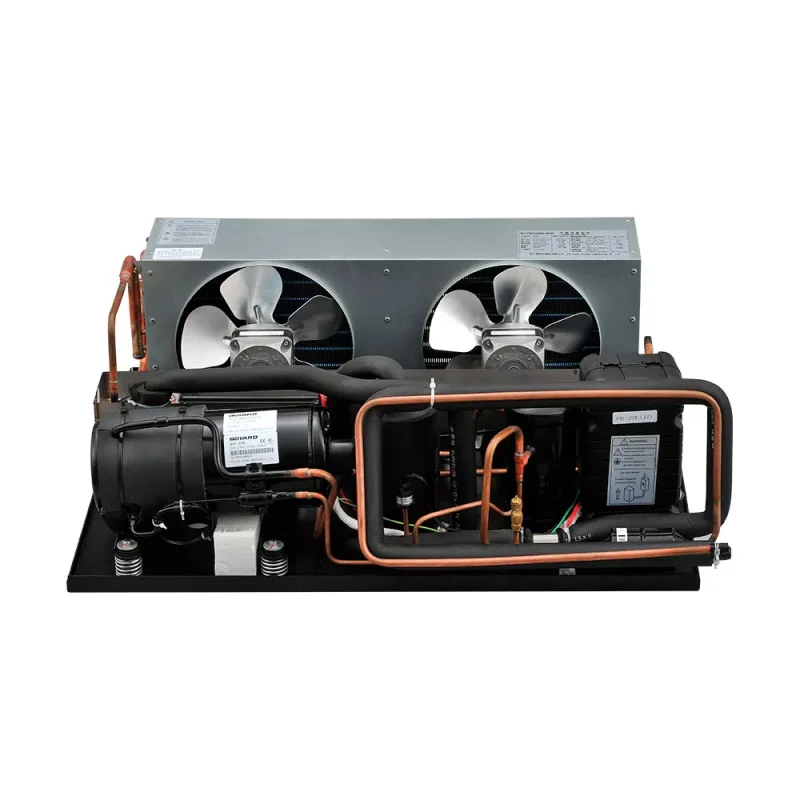
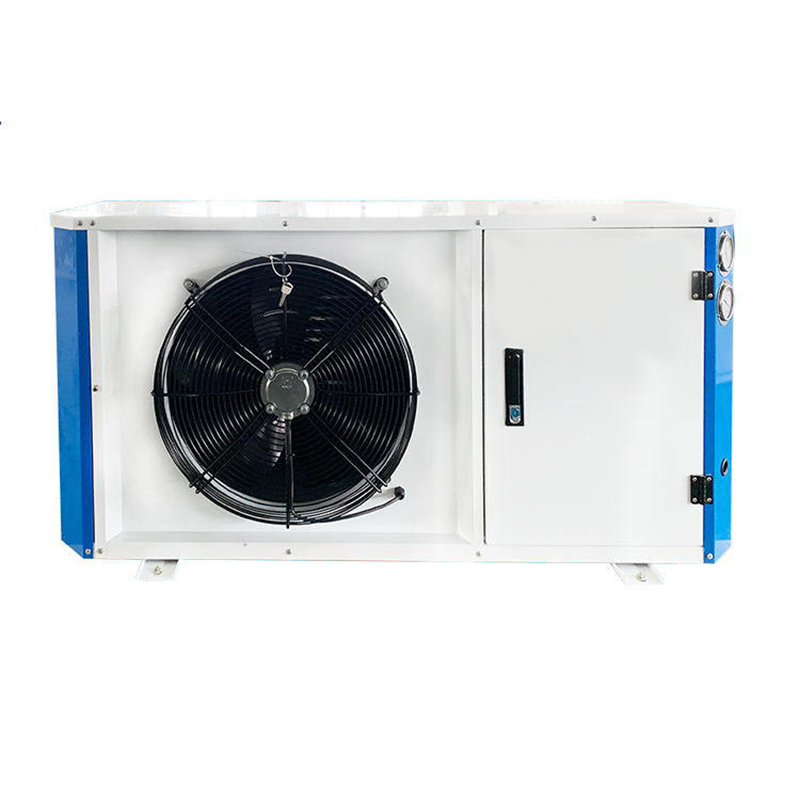
The Danfoss MLZ021 is a 2 HP-class hermetic scroll compressor designed for medium and high evaporation temperature applications. Mounted into an open, box-type air-cooled condensing unit, it becomes a self-contained refrigeration package: compressor, air-cooled condenser, axial fans, liquid receiver, pressure switches and electrical box on one rigid frame.
For contractors, the practical appeal is serviceability. An open chassis gives full access to the compressor terminals, the suction and discharge connections and the receiver valve — no sealed panel to wrestle with on a rooftop. For end users, the appeal is predictable performance in medium-temperature cold rooms, preparation kitchens and processing areas, where reliability matters more than a headline COP number.
| Attribute | Typical Specification | Why It Matters on Site |
|---|---|---|
| Compressor platform | Danfoss MLZ021 scroll, 2 HP class | Fewer moving parts than reciprocating equivalents; quieter, lower vibration |
| Application range | Medium / high evaporating temperature | Suited to chilled rooms, prep areas and processing spaces |
| Refrigerant options | R404A, R452A, and R448A/R449A subject to selection check | Keeps the project viable as R404A stock declines |
| Lubricant | POE (polyolester) | Hygroscopic — correct charging and evacuation procedures are essential |
| Power supply | 220–240 V / 1 Ph / 50 Hz; 380–415 V / 3 Ph / 50 Hz variants | Confirm against the actual site supply, not the tender drawing |
| Construction | Open box-type frame, air-cooled condenser, axial fan(s) | Straightforward maintenance access and component replacement |
Always verify final capacities and permitted refrigerants against the current Danfoss selection software and the unit's data plate before ordering.
How to Read the Pain Points Correctly
Expand each item for the practical workaround.
Selection: read capacity at your real operating point
Two cold rooms of identical volume can need units a size apart. The deciding factors are product load, door traffic, insulation quality, ambient temperature at the condenser and the pull-down requirement. Always ask for capacity data at the evaporation temperature your application actually runs at, and cross-check it against the unit's rated ambient. A unit selected at 32 °C ambient, installed against a sun-facing wall in a 40 °C climate, is under-sized no matter what the datasheet says.
Brand and configuration: check the parts you cannot see
An authentic compressor is necessary but not sufficient. Ask about the condenser coil (tube and fin material, fin pitch, coating), fan motor insulation class and IP rating, receiver capacity, whether a liquid line filter drier and sight glass are included, and how the electrical panel is protected. These are exactly the items that determine how the unit behaves in year three, and exactly the items that quietly disappear from a low-cost quotation.
Voltage: match the site, not the drawing
Single-phase installations in retrofit buildings often suffer from start-up voltage dips; three-phase sites frequently show phase imbalance that a scroll compressor dislikes. Confirm nominal voltage, phase, frequency and tolerable fluctuation range before the order is placed, and specify the correct motor protection. If the supply is unstable, that is a design conversation, not something to solve at commissioning.
Refrigerant: decide once, engineer properly
R404A remains widely available but its GWP makes it increasingly unattractive under modern regulations. R452A is a common drop-in-oriented alternative; R448A and R449A are also widely used in medium-temperature systems. What must never be improvised is the combination: refrigerant, oil, expansion valve and charge weight all have to agree. A unit correctly ordered for the wrong refrigerant is a warranty conversation waiting to happen.
Lead time: verify stock before promising a handover
Project schedules are built backwards from commissioning. If the condensing unit is on allocation or build-to-order, that date moves. Confirm whether the configuration you want is ex-stock or needs production, and book buffer time for freight and customs. Getting a firm delivery window in writing is worth more than a marginally lower price.
Budget: compare total cost, not invoice price
A cheap condensing unit with a poorly matched coil will run longer cycles, consume more energy and lose more refrigerant over its life. Build a simple five-year view: purchase price, expected annual energy consumption, refrigerant top-up allowance and service frequency. In medium-temperature commercial refrigeration, the gap between a good match and a poor one usually pays for itself well within that window.
Interactive: Three Steps to a Sensible Starting Configuration
This is a conversation starter, not a substitute for a proper engineering selection.
Pre-Order Checklist for Contractors and Buyers
Tick these off before the purchase order goes out.
- Capacity confirmed at the project's actual evaporation and ambient temperatures.
- Nominal voltage, phase and frequency verified against the real site supply.
- Refrigerant selected, with expansion valve and oil compatibility confirmed.
- Condenser coil specification, fan motor rating and receiver volume reviewed in writing.
- Electrical protection, pressure switches and accessories listed line by line.
- Delivery window confirmed — ex-stock or build-to-order.
- Five-year cost comparison done against at least one alternative configuration.
- Documentation, data plate and warranty terms received before shipment.
When all eight boxes are ticked, the MLZ021 box-type unit stops being a line item and becomes a predictable part of the installation. That is what a good procurement decision actually looks like.
Still Comparing Configurations?
Send us your cold room conditions — evaporation temperature, ambient, refrigerant, voltage and target delivery date — and we will come back with a concrete configuration and a realistic lead time. No obligation, no generic catalogue copy.
Request a Configuration Review