Parallel Condensing Units: Key Advantages and the Control Points That Keep Them Reliable
Most refrigeration loads rarely run at design capacity. A well-designed parallel condensing unit matches capacity to real demand — and the difference shows up in energy bills, uptime and service costs.
What This Article Covers
- How multiple compressors share one condensing circuit
- Why stepped capacity control saves energy at part load
- Built-in standby redundancy and space savings
- The control essentials: run-hour balancing, oil equalisation, oil return, and protection against liquid floodback and oil starvation
A refrigeration plant spends most of its working life somewhere below full capacity. Demand rises in the middle of the day and falls away at night; it shifts with product load, ambient temperature and door traffic. A single large compressor can only respond by starting and stopping, which is hard on the machine and wasteful on power. A parallel condensing unit takes a different approach: it spreads the duty across several compressors that operate together as one system, so capacity can be added or removed in steps as the load moves.
What a Parallel Condensing Unit Actually Is
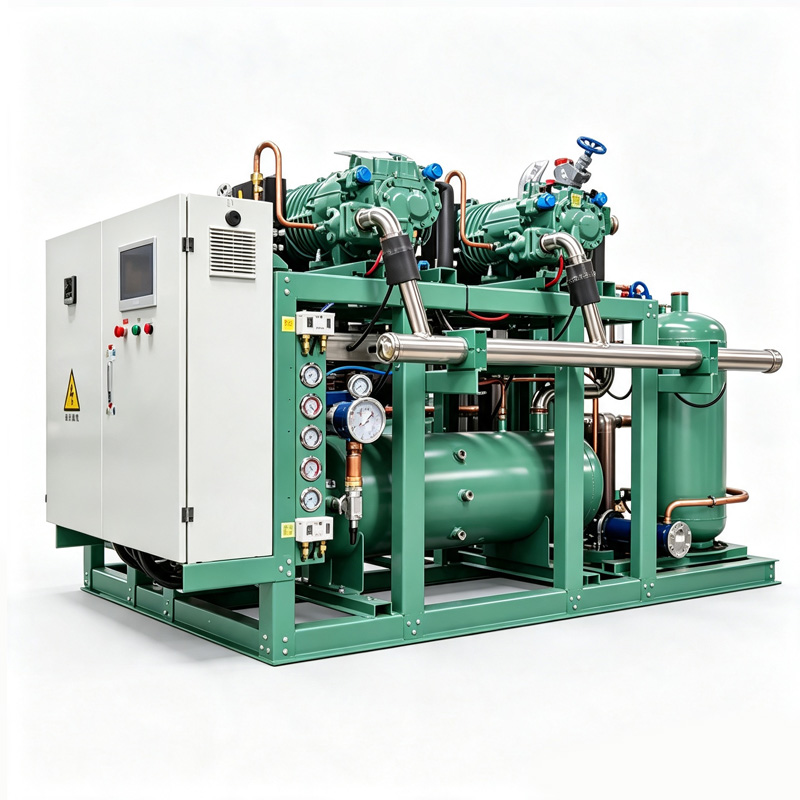
In a parallel arrangement, two or more compressors are piped into a common suction header and a common discharge header. They share one condenser, one receiver and one set of liquid lines, and they are managed by a single controller that decides how many compressors should be running at any moment.
That shared condensing circuit is the defining feature. Because the compressors discharge into the same condenser, the system behaves as one coordinated machine rather than a collection of independent units. The controller sees the whole picture — suction pressure, discharge pressure, superheat, run hours — and distributes the work accordingly.
Advantages of Parallel Condensing Units
Capacity that follows the load, step by step
Stepped or staged capacity control lets the system run at 25%, 50%, 75% or 100% of total capacity by switching compressors in and out. Instead of one machine cycling violently around the setpoint, the plant delivers only what the load requires. Suction pressure stays steadier, product temperature is easier to hold, and the compressor that is running stays within an efficient operating envelope rather than short-cycling.
Real energy savings at part load
This is where the economics become compelling. Part-load operation is the normal condition, not the exception, and a staged system tracks it closely. Running two compressors at partial load is generally more efficient than running one oversized compressor at low load with frequent restarts, because cycling wastes energy on every start and adds wear to the motor and contactors. Softer pressure control also reduces the discharge temperature swings that push a system toward unnecessary head pressure.
Compressors act as standby for one another
Because the machines are parallel, no single compressor is a point of total failure. If one is taken offline for service or develops a fault, the remaining units can cover a meaningful share of the load until repairs are complete. For cold storage, food processing or any operation where a temperature excursion means lost product, that built-in redundancy is often worth more than the efficiency gain alone.
Less floor space, fewer components
One condenser, one receiver, one control panel and one pipework network replace what would otherwise be several separate systems. The footprint shrinks, the installation is simpler, and there are fewer joints, valves and connections to leak or maintain. On a crowded plant floor or a rooftop with limited structural capacity, that compactness frequently decides the design.
Control Points That Determine Long-Term Reliability
The advantages above only hold if the system is controlled properly. Parallel operation introduces interactions between compressors that a single-compressor plant never has to deal with. These are the areas that deserve the closest attention.
Balancing running hours
Not every compressor should carry the same duty. A well-configured controller rotates the lead machine on a schedule or by accumulated run hours, so wear is spread evenly across the group. This avoids the common failure pattern where one compressor reaches the end of its service life years before its neighbours, and it keeps maintenance predictable.
Oil equalisation between compressors
Parallel compressors share a common oil management problem: oil leaves with the discharge gas and does not always return to the compressor it came from. Without an equalisation strategy — an oil header, equalising lines, or an active oil management system — one machine can gradually run low while another fills up. Equalisation keeps oil level consistent across the group, which protects every compressor from the consequences of running dry.
Oil return through the pipework
Oil that leaves the compressor must find its way back. Suction and discharge lines should be sized and sloped so that gas velocity carries oil along rather than letting it pool in low spots. Traps, risers and long horizontal runs need deliberate design, especially where load varies widely and gas velocity drops during part-load operation. Poor oil return is one of the most common causes of premature compressor failure in parallel systems.
Preventing liquid floodback
Liquid refrigerant reaching the compressor can dilute the oil, wash bearings and cause slugging. In a parallel system the risk is higher because the common suction header is shared by several machines. Protection typically includes correctly set superheat at the evaporator, suction accumulators, crankcase heaters, and pump-down or defrost sequences that keep liquid out of the header during transitions. The controller should also prevent a compressor from starting while conditions still favour liquid return.
Preventing oil starvation
The reverse problem — too little oil at the compressor — is just as damaging. Low oil level trips, oil pressure safety switches and differential pressure monitoring give the controller a way to protect each machine individually. If one compressor in the group shows a falling oil level or a loss of oil pressure, the control strategy should respond before damage occurs, not after.
Taken together, these control points are what separate a parallel condensing unit that performs for fifteen years from one that becomes a maintenance liability. The hardware sets the ceiling; the control logic determines whether the system actually reaches it.
Build Your System on a Proven Foundation
From component selection to oil management and control configuration, the right partner makes the difference between a parallel condensing unit that simply runs and one that performs for decades. Explore the range and technical support available at LandaCompressor.
Visit landacompressor.com →