
Condensing Unit Selection in High‑Ambient Environments (>45°C)
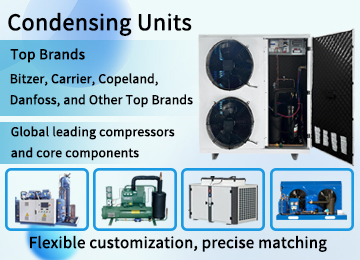
Why Standard Ratings Fail in High Heat: Engineered Solutions for Uncompromised Reliability.
Global warming and urban heat islands are pushing design ambient temperatures far beyond traditional 35°C baselines. For refrigeration and air‑conditioning systems, every degree above 45°C brings non‑linear penalties: compressor capacity erodes, power consumption climbs, and the risk of thermal shutdown becomes a weekly threat. This guide consolidates engineering best practices, real‑world derating data, and selection checklists to help you specify condensing units that not only survive extreme heat but deliver stable performance across a 10‑year lifecycle.
1. The Reality of Capacity Derating
At 45°C, an air‑cooled condensing unit typically loses 13‑18% of its nominal cooling capacity. Push to 50°C, and the loss approaches 30%, while COP can drop by more than 35% compared to the AHRI rating point. The chart below illustrates typical behavior for medium‑temperature R‑404A scroll compressors—but the trend holds for most HFC and HFO blends.
| Ambient Temp. | Relative Capacity (%) | COP Reduction (%) | Discharge Temp. (°C) | Risk Level |
|---|---|---|---|---|
| 35 °C (baseline) | 100 | 0 | ~92 | Safe |
| 40 °C | 93 | ‑8 | ~98 | Monitor |
| 45 °C | 84 | ‑18 | ~105 | Caution |
| 48 °C | 76 | ‑26 | ~111 | High |
| 50 °C | 69 | ‑33 | >115 | Critical |
Data based on typical 3‑7 HP scroll compressors; actual values depend on refrigerant, superheat, and evaporator load. Always use manufacturer selection software for final sizing.
2. Five Strategic Upgrades for Hot Climates
Oversizing a standard unit is a common but flawed approach—it wastes energy and raises first cost without addressing the fundamental thermal bottleneck. Instead, apply these five targeted measures:
🔹 Enlarge Condenser Coil Surface Area
Increase the coil face area by 25‑35% compared to a 35°C selection. A larger coil reduces the required condensing temperature for the same heat rejection, directly improving compressor volumetric efficiency. In practice, this may mean choosing a condenser with 3‑row vs. 2‑row tubes, or increasing fin density (but watch out for fouling).
🔹 Upgrade Fan Airflow & Static Pressure
Standard fans often lose 10‑15% airflow when air density drops at high temperature. Select fans with a steeper pressure‑volume curve and motor service factor ≥1.15. EC (electronically commutated) fans with speed control are highly recommended—they maintain set airflow even when ambient temperature fluctuates, and they reduce noise during part‑load.
🔹 Specify High‑Ambient Compressors
Not all compressors are created equal. Look for “T‑class” or “high‑temperature” variants that feature:
- Larger displacement per revolution to compensate for suction gas density loss.
- Enhanced motor cooling paths (e.g., suction gas cooled or liquid injection).
- Higher insulation class (F or H) and thermal overload protection with higher trip thresholds.
🔹 Strict Condensing Temperature Limits
Never allow condensing temperature to exceed the compressor’s absolute maximum—typically 60‒65°C for R‑410A and 55‒60°C for R‑134a. Exceed this even for short periods, and oil viscosity drops dangerously, bearings wear prematurely, and the motor windings can suffer insulation breakdown. Install a dedicated high‑pressure safety cut‑out set at 5°C below the manufacturer limit.
🔹 Evaporative Pre‑Cooling (Mist / Spray)
When dry‑bulb extremes are unavoidable, an adiabatic pre‑cooler or spray system on the condenser air intake can lower effective ambient temperature by 5‑8°C. However, this solution adds water management complexity. Critical note: untreated water leads to scale buildup and corrosion within weeks. Use softened water (<100 ppm hardness), add biocides, and schedule monthly coil cleaning. With proper maintenance, evaporative assist can extend the operating envelope to 52°C without oversizing the compressor.
3. Practical Selection Checklist (for 45‑50°C Sites)
Use the following quantitative guidelines during your tender or specification phase:
4. Simulation, Not Guesswork
Do not rely on rule‑of‑thumb multipliers. Use the compressor manufacturer’s official selection software (e.g., Bitzer 6.x, Copeland Select, or Danfoss CoolSelector) with your actual site‑specific peak ambient—include solar radiation on the condenser panel and potential recirculation from adjacent equipment. Run the simulation at 110% of the worst‑case ambient to build in a safety margin. Many engineers overlook the effect of altitude: above 1000 m, both air density and fan performance drop, adding another derating factor of 2‑4% per 500 m.
Additionally, consider split condenser circuits for large systems. By dividing the condenser into two independent sections, one fan can run at high speed while the other modulates, balancing total airflow and reducing the inrush current. This also provides redundancy—if one fan motor fails, the system can still operate at reduced capacity rather than tripping.
5. Installation & Maintenance – The Silent Success Factors
Even a perfectly selected unit will fail prematurely if installed incorrectly. Ensure:
- Clearance: maintain at least 1.5‑2 m on the intake side and 2 m on the discharge side to prevent hot air recirculation. Use wind baffles if the unit is mounted on a roof with parapet walls.
- Piping: keep liquid lines as short as possible and insulate suction lines to prevent flash gas. Use oversized liquid lines to reduce pressure drop, which otherwise raises the effective condensing pressure.
- Coil cleaning: in dusty or coastal areas, schedule a coil wash every 3‑4 months. Use mild alkaline detergents and rinse thoroughly—never use high‑pressure washers that can bend fins.
6. Cost‑Benefit Perspective
Investing in a high‑ambient condensing unit typically adds 20‑30% to the initial equipment cost compared to a standard‑duty model. However, this premium pays back within 12‑18 months through reduced energy consumption (lower condensing pressure) and avoided downtime. In food storage or pharmaceutical applications, a single day of system failure can cost more than the entire unit—so the total cost of ownership heavily favours a robust high‑temperature design.
📊 Quick payback estimator – For a 20 kW cooling system operating 4000 h/year at 48°C, the efficiency gain from optimised condenser selection (vs. undersized unit) saves ≈ 8,500 kWh annually, equivalent to 4‑6 tonnes of CO₂ emissions and roughly $1,200–1,500 in electricity costs (at $0.15/kWh).
7. The Role of Refrigerant Choice
While this article focuses on mechanical selection, refrigerant chemistry also matters. R‑134a has a lower critical temperature (101°C) and tends to perform poorly above 50°C. R‑410A and R‑32 are more tolerant, but their discharge temperatures are higher. For very high ambient (>50°C), consider R‑454B or CO₂ (R‑744) transcritical systems—but these require completely different component designs. For most conventional applications, the safest route is to stay with a well‑characterised HFO blend and apply the coil/fan upgrades described above.
8. Final Integrated Strategy
To summarise, a robust high‑ambient condensing unit specification should include:
- Condenser sized for at least 30% higher heat rejection than the nominal cooling load.
- Fan system capable of maintaining ≥ 2.5 m³/h per kW of rejected heat at 50°C air density.
- Compressor with extended envelope (T‑class) and discharge temperature protection.
- Evaporative pre‑cooling only if water quality and maintenance are guaranteed.
- Real‑world simulation at peak solar hour (not just dry‑bulb average).
By following these guidelines, you can achieve a condensing unit that not only meets the nameplate capacity but does so with lower condensing pressure, longer compressor life, and predictable energy bills—even during the hottest afternoon in July.
Need customised high‑temperature condensing units?
Explore our engineering tools, project references, and technical datasheets at landacompressor.com – we specialise in robust solutions for harsh climates.
How to Match Evaporating Temperature and Compression Ratio in Low-Temperature Cold Storage Condensing Units
How to Determine the Optimal Refrigerant Charge in a Condensing Unit – A Complete Technical Guide


